

The Seven Spirits


I want to share a passage that comes from the Testament of Reuben. The work in its surviving form is generally dated somewhere within the late Second Temple period, perhaps around the first century BCE or the beginning of the first century CE. The collection may have been in Hebrew at some point but was preserved and transmitted via Greek manuscripts that the Christian scribes edited for their use. The original form of the text did not survive intact. Yet the Testaments of the Twelve Patriarchs is a thoroughly Jewish spiritual work presented as the final words of the twelve sons of Jacob.
Modern readers should be aware that these words were not actually written by the patriarchs themselves. The admonitions are pseudepigraphical, meaning that a later author wrote in the name of an ancient figure. The texts also contain ideas and concerns that clearly belong to a much later period than the patriarchs themselves. Setting aside this matter of authorship, the Testaments of the Twelve Patriarchs preserve a remarkable collection of Jewish wisdom, ethical teaching, biblical interpretation, and reflections on human behavior. They are valuable precisely because they show how some Jews of the late Second Temple period connected contemporary spiritual concerns to the stories and traditions of Israel's ancient ancestors.
In this fragment, Reuben, who traditionally lived to 125, offers a final charge to his sons before his death. In the middle of his admonitions, he pauses to explain how human beings were created with a remarkable collection of capacities and impulses. And this is where the text gets interesting:
And when he was raised up he kissed them and said to them, “Listen, my brothers and my sons; give heed to the things which I, Reuben, your father, command you. See here, I call the God of heaven to bear witness to you this day, so that you will not behave yourselves in the ignorant ways of youth and sexual promiscuity in which I indulged myself and defiled the marriage bed of my father, Jacob… And now give heed to me, my children, concerning the things which I saw during my time of penitence, concerning the seven spirits of deceit. For seven spirits are established against mankind, and they are the sources of the deeds of youth. And seven other spirits are given to man at creation so that by them every human deed (is done). First is the spirit of life, with which man is created as a composite being. The second is the spirit of seeing, with which comes desire. The third is the spirit of hearing, with which comes instruction. The fourth is the spirit of smell, with which is given taste for drawing air and breath. The fifth is the spirit of speech, with which comes knowledge. The sixth is the spirit of taste for consuming food and drink; by it comes strength, because in food is the substance of strength. The seventh is the spirit of procreation and intercourse, with which come sins through fondness for pleasure. For this reason, it was the last in the creation and the first in youth, because it is filled with ignorance; it leads the young person like a blind man into a ditch and like an animal over a cliff. In addition to all is an eighth spirit: sleep, with which is created, the ecstasy of nature and the image of death. With these are commingled the spirits of error. (The Testament of Reuben 1-3.2, R.H. Charles trans.)
So, seven spirits were given to humanity at creation. No, eight, maybe more? Actually, the text also mentions the seven spirits of deceit that oppose humanity as well. This is where modern readers can easily become confused. Many people today have been taught to think about human beings according to a body, soul, and spirit model. In popular Christian language, these three terms are often treated as if they describe three clearly distinguishable components that make up a human. The body is physical, the soul is emotional or psychological, and the spirit is the immaterial or divine part of a human being. But this neat tripartite scheme should not simply be projected backward onto Jewish texts from the Second Temple period.
The Hebrew Bible does not present a single, systematic body-soul-spirit anthropology in which these terms always refer to three clearly separated parts of a human being. The Hebrew word רוּחַ (ruach), for example, can refer to wind, breath, vitality, disposition, courage, emotion, or spirit, depending on the context. The word נֶפֶשׁ (nefesh) can refer to a living being, life, desire, or the self. These categories frequently overlap. In Genesis 2:7, a human becomes a living נֶפֶשׁ (nefesh). Yet the text does not describe three independent substances being assembled together, just a union of body and divine breath.
In Hebrew, a person's spirit can be troubled, strengthened, broken, or stirred. A person's soul can hunger, thirst, desire, and experience distress. The language is relational and highly functional rather than a structured, rigid scheme of the invisible puzzle pieces that make up a human. This is an important realization when reading the Testament of Reuben. The author is not necessarily describing seven spiritual parts of beings living inside the human body. Nor is he dividing the human person into seven separable segments. Instead, he appears to be describing the various capacities and impulses through which human beings live: life, sight, hearing, smell and breath, speech, taste and nourishment, sexual desire and procreation. In addition to these, the writer adds sleep.
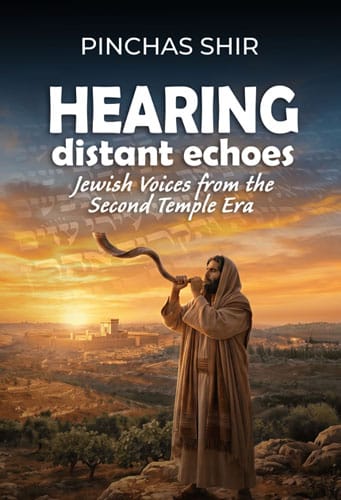
This article is an adapted excerpt from one of my books... This book captures many ancient voices, a collection of literary excerpts from ancient Jewish books: Jubilees, Josephus, 4 Ezra, Qumran Scrolls, Talmud, Enoch, Baruch, Maccabees, Mishna, Judith, Apocalypse of Moses, Philo, Mishna, Ben Sira, and many others- fifty passages to be exact.