
Rethinking Jewish Spirituality and Mysticism



This is a lecture by Rachel Elior, a Professor of Jewish Philosophy and Jewish Mystical Thought at the Hebrew University, a talk given in front of an audience of peers. Her research is insightful and often challenges the status quo academic thinking. In this segment, she raises questions of definitions by which we categorize and understand religion, spirituality, and mysticism today. What is mysticism and what it is not? These are important questions as we frame our understanding of human spiritual experiences.
Disclaimer: Academic lectures are not for everyone. But if you enjoy this sort of learning, Prof. Elior's ideas are quite insightful and should be considered.
ATTENTION: To engage with media inside your email, tap the "view in browser" link (next to the title on top) or go to www.pshir.com directly and enjoy playing the media there. Not all videos play right inside the email software.
Dr. Elior's central thesis is that Jewish mysticism is not irrational, but rather a profound imaginative response to historical trauma and the absence of physical freedom. She identifies two major branches, both born from catastrophe: Chariot Mysticism (Merkavah), which emerged after the destruction of the Temple when mystics reconstructed the Temple in the heavenly realm, linking priests to angels and correlating sacrifices to prayer; and Kabbalistic, or Sefirot Mysticism, which arose after the expulsion of Jews from Spain, offering a new divine structure and messianic hope to make sense of suffering. Unlike Jewish law (Halakha), which sets communal boundaries, mysticism offered an individual, creative space for spiritual freedom.
Elior proposes that mysticism served as a vital survival mechanism for many Jews, a way for a historically marginalized people to decode painful realities and construct hopeful futures through radical reinterpretation of sacred texts. The enduring legacy of Jewish mysticism, she argues, is not a set of supernatural beliefs, but the profound freedom to reinterpret, reimagine, and continuously recreate meaning, sustaining a distinct identity across generations of exile and trauma.
If you are interested in Prof. Elior's books, she has one called "Jewish Mysticism: The Infinite Expression of Freedom" that unfolds the ideas in this lecture further. Another book that goes much more into history is "The Three Temples: On the Emergence of Jewish Mysticism," a volume that provides a solid grounding in the development of Jewish Mysticism.
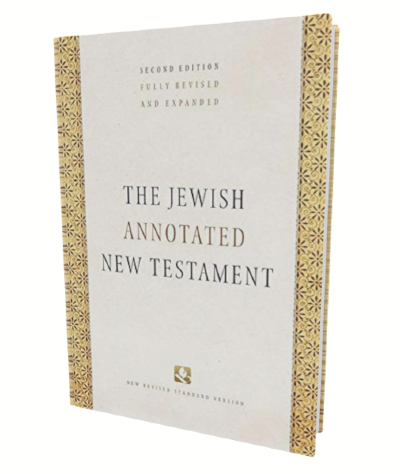
The Annotated Jewish New Testament (NRSV)
This New Testament was not designed for an average reader. Edited by Amy-Jill Levine and published by Oxford University Press, this intriguing edition contains academic notes and verse-by-verse commentary on the New Testament by scholars of religion who happen to be Jews. This unique volume contains many helpful and concise topical articles that delve into cultural and historical issues that a student of the first-century Jewish context might encounter.